
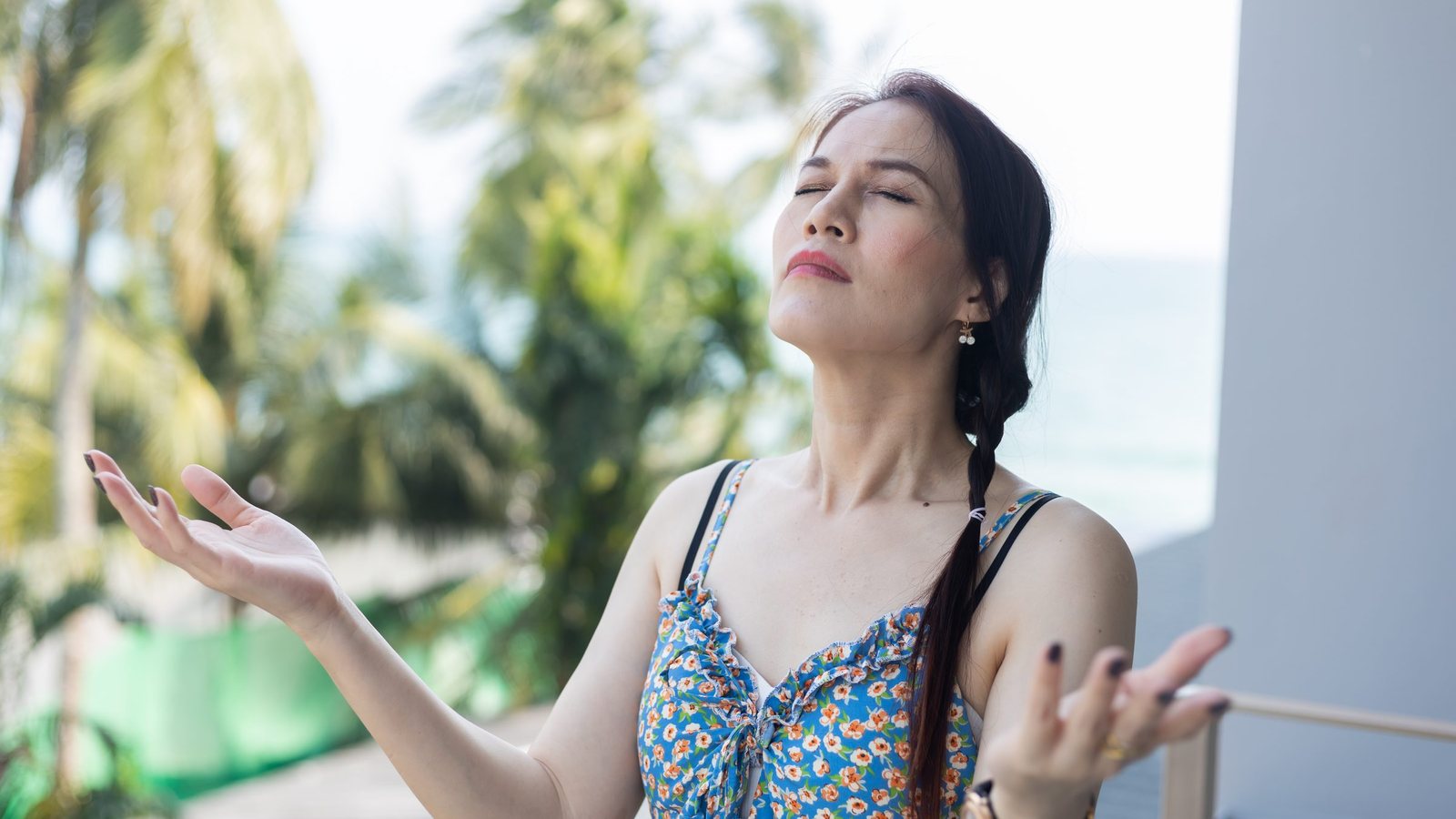
Guide: Stop stress fast
- Two breaths in, one long breath out. Why the physiological sigh works in under a minute and how to do it on your own.
There is that moment when things tip. The child is screaming, the supermarket is too loud, your own voice is getting sharp. You know exactly what would come next if you did nothing.
For exactly this moment there is an exercise shorter than the walk to the door: the physiological sigh. Two breaths in, one long breath out. In the app, Stop stress fast guides you through the rounds, with rhythm, shape and voice. Here is the same exercise to read up on, for the moments when you don't want to pull out your phone at all.
Why it works
Two things happen at once.
The double inhale opens the lungs. Under stress we breathe shallowly, and some of the tiny air sacs collapse. The second, short sip on top unfolds them again. Only then can the exhale that follows really release something.
The long exhale brakes. Breathing out engages the vagus nerve, the part of the nervous system that switches to calm. Heart rate down, arousal down. That is why the exhale here is longer than the inhale, and not the other way round.
And then there is what sets this exercise apart from all the others: it asks nothing of you. No counting, no holding, no sequence to remember. Your body sighs by itself anyway, several times an hour. You are only doing it deliberately. Which is exactly why it still works when thinking no longer does.
What it gives you
It takes the edge off. After four rounds, around forty seconds, the pressure is low enough that you can decide again instead of only reacting.
What it is not: recovery. A sigh replaces no retreat, no sleep, no break. It is the emergency brake, not the calm afterwards.
How to do it
1. Stay where you are

You don't have to leave the room or sit down. Standing, in the middle of the noise, with a child on your arm: it works. Let your shoulders drop once. That is all the preparation it takes.
2. Breathe in through your nose

About three seconds, calmly, not to the maximum. Roughly two thirds full is right, you'll need room in a moment.
3. Add a short second breath

Now the part that feels unfamiliar: without breathing out, take another short sip on top, through the nose again. A small catch of air, about a second. That is the move that opens the lungs all the way.
4. Breathe out long through your mouth

Five to six seconds, audible, like a sigh. Let the air escape rather than pushing it. At the end your shoulders may sink with it.
5. Four rounds, then notice
Repeat the whole thing four times, that is about forty seconds. Then a few normal breaths without steering anything. It is in that pause that you notice what has changed.
More rounds are fine if you have the time, up to ten makes sense. Fewer too: even a single deliberate sigh shifts something.
When it doesn't fit
- Feeling dizzy? Then breathe normally and leave the exercise. Dizziness usually means: too deep, too fast. Breathe in less next time.
- Body wired and wanting to move? Get it out first, then sigh. Shake off tension fits better before this one.
- You don't want to take the edge off but really come down? Then Lower your pulse or Relax deeply are the exercises for that. The sigh carries you over the moment, those two carry you into calm.
Where this comes from
A randomised study from the Stanford group around David Spiegel and Andrew Huberman compared four methods, five minutes daily each: meditation, box breathing, cyclic hyperventilation and cyclic sighing. Sighing improved mood the most and lowered breathing rate the most (Balban et al., Cell Reports Medicine, 2023).
The double-inhale reflex itself is older than any exercise. It is built into the body and keeps the lungs open in everyday life. All we do here is use what is there anyway.
It continues in the app
bloomnow is there for exactly the moments this text is about: tools for the hard minutes, videos from professionals, and a community that knows the same everyday life.
Get the app