
Guide: For falling asleep
- Four in, seven hold, eight out. Why the long exhale makes you sleepy and how to run the exercise in bed without your phone.
Your body finished hours ago, your head did not. You are lying in bed and in the background it keeps running: tomorrow's appointment, that sentence from the teacher, the list. Turning over doesn't help, because the problem isn't your position.
This exercise gives your head something to do and your body a signal. Four seconds in, seven hold, eight out. In the app, For falling asleep guides you through the rounds. Here is the same exercise to read up on, so you can do it in the dark without turning on a screen.
Why it works
The numbers are not arbitrary, but they are not magic either. What matters is the ratio: the exhale is twice as long as the inhale. That ratio tips the nervous system towards calm, because the exhale phase engages the vagus nerve and slows the heart.
The hold in between does two things. It slows the breathing rate further, and it builds up a little carbon dioxide, which settles the urge to breathe rather than rushing it.
And then there is the part that matters more than physiology at night: counting occupies your head. Three different numbers are just demanding enough that the thought carousel has no room left, and simple enough not to wake you up. For many ADHD brains that is exactly where this exercise takes hold.
What it gives you
It switches you from doing-mode to letting go. Four rounds take a good minute. Often you don't notice getting tired. You notice that you stopped thinking ahead.
What it is not: a sleeping pill. It makes falling asleep easier, it doesn't force it. And if you haven't slept for weeks, that is not a case for a breathing exercise but one for a doctor.
How to do it
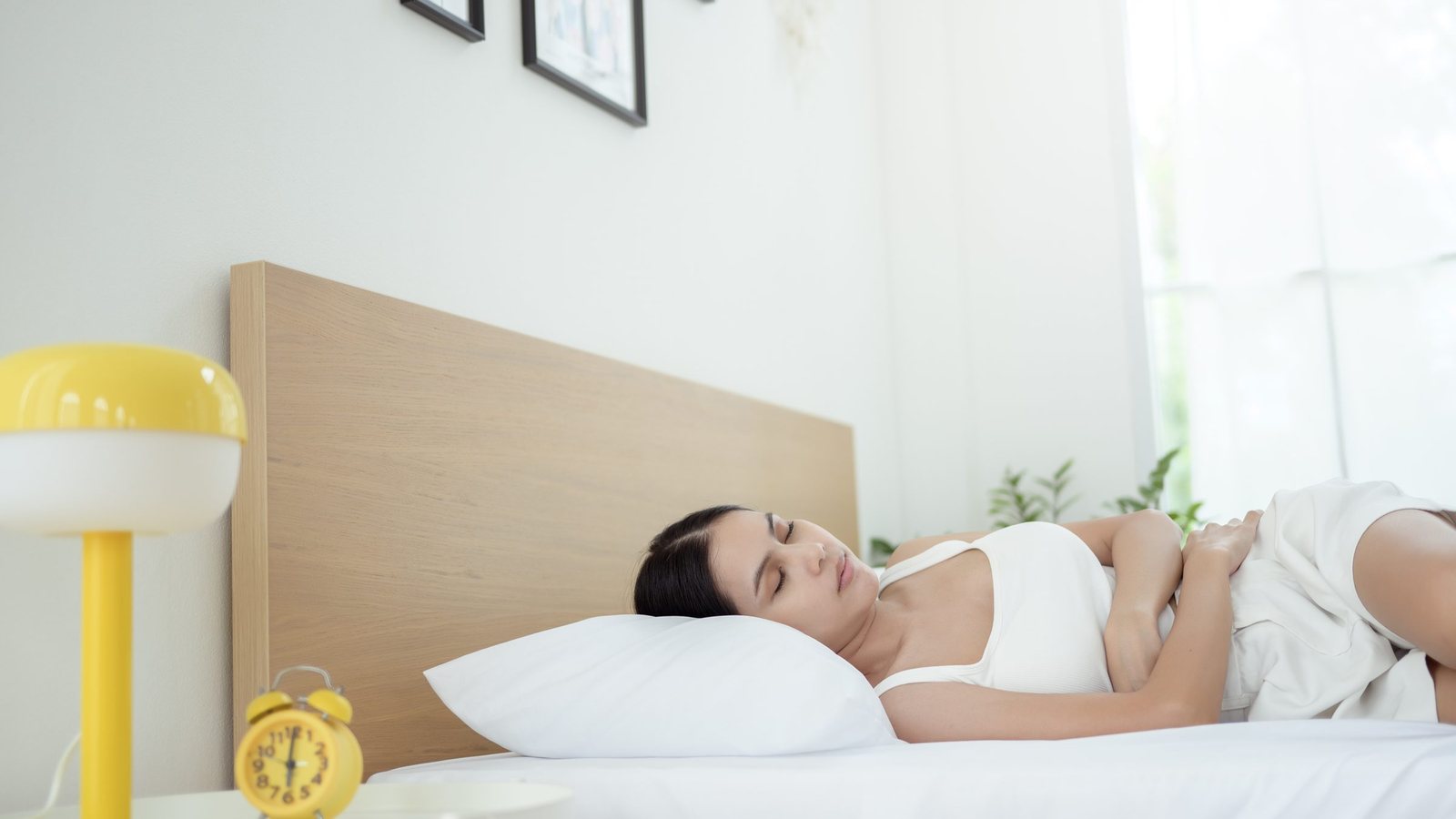
1. Lie down the way you want to sleep

On your back is easiest, on your side works just as well. Let your shoulders sink into the pillow. Resting your tongue loosely behind your upper front teeth makes the exhale easier later, but it is not a must.
2. Breathe in for four seconds

Quietly, through the nose, not deeply. At night less is better: a big inhale makes you more awake, not sleepier.
3. Hold for seven seconds

Hold loosely, don't clamp down. No pressing in the throat, no tensing in the belly. If seven is too long, hold five. The ratio may shift; the pressure must not rise.
4. Breathe out for eight seconds

Through slightly parted lips, audibly, like a long stream flowing out. This is the actual part of the exercise. Let the air run rather than pushing it, and let everything get heavy while it does.
5. Four rounds, then stop
Four rounds are enough. Then stop counting and breathe normally. Longer is explicitly not better here: extended breath holding quickly becomes uncomfortable, and this exercise is meant to carry you into sleep, not to keep you busy.
When it doesn't fit
- Does the hold feel tight or panicky? Then drop it. Breathe in for four and out for eight, or take the gentler four, six, eight version. The long exhale is the active ingredient; the hold only amplifies it.
- Getting more awake instead of sleepier? Usually that is too deep an inhale. Breathe in smaller, out longer.
- Lying awake with a restless body? Then something physical helps more than breathing first, for example Relax your muscles.
- It's evening but you are not in bed yet? Then Relax deeply is the better fit: equal in and out, no holds.
Where this comes from
4-7-8 breathing was popularised by Andrew Weil and has barely been studied as that specific number pattern. Its working principle, however, is well documented: an exhale longer than the inhale increases parasympathetic activity and lowers arousal. Systematic reviews of slow breathing (Zaccaro et al., Frontiers in Human Neuroscience, 2018) show this consistently.
Put differently: the specific numbers are a practical scaffold, not a recipe. If your version feels better and the exhale stays the longest phase, then your version is the right one.
It continues in the app
bloomnow is there for exactly the moments this text is about: tools for the hard minutes, videos from professionals, and a community that knows the same everyday life.
Get the app